Ports

Certified Pick Up - Antwerp

Port of Antwerp Says ‘Certified Pick Up’ Proceeding Smoothly

March 12, 2021 - The Port of Antwerp said that ‘Certified Pick up’ has been in use at the port of Antwerp since January 2021 and the new system is working well.

“The digital, safe and integrated solution for the release of containers is a long-term replacement for the current PIN code system. The new way of working guarantees a secure, transparent and optimised release process for incoming containers, which will then leave the port by rail, inland navigation or truck.” the Port said.

“Signing up to Certified Pick up is mandatory if you are involved in the container release process in Antwerp. This central data platform was developed by NxtPort. At present, nearly 90% of all the shipping companies and terminals in Antwerp have signed up to the system,” the Port added.

Transparency around container status

In this initial phase, Certified Pick up offers transparency around the status of your incoming container in the form of a series of "green lights". When all the lights in the application are on green, you can see at a glance whether the container is ready for collection. This improves operational efficiency for all the users involved.

PIN codes will be gone for good

Port of Antwerp has chosen a phased approach to guarantee the stable expansion of the system. In the next phase, the various chain partners will switch from the PIN code system to the new handling method with pick-up based on encrypted identification and authorisation data.

Truck drivers will pick up containers by identifying themselves digitally. PIN codes will no longer be used for inland navigation or rail, either. The use of Certified Pick up will be mandatory from then on. The legal framework is included in the Port Police Regulations.

SOURCE: Port of Antwerp


Port of Los Angeles

Port Of Los Angeles Launches New ‘Control Tower’ Data Tool for Tracking Cargo

Service provides real-time truck turn-time data and other metrics to boost advanced planning capabilities for Port stakeholders

March 1, 2021 - As part of its ongoing push to further digitalize the port supply chain and  improve cargo efficiency and fluidity, the Port of Los Angeles has introduced a new “Control Tower” data tool — the third such instrument introduced by the nation’s busiest trade gateway in less than six months. The Control Tower offers real-time views of truck turn times, as well as other truck capacity management information, to help cargo owners, truckers and other supply chain stakeholders better predict and plan cargo flows.

“The Control Tower is a service and digital tool that will help get critical and reliable information to San Pedro Bay port stakeholders so that they can improve decision making and efficiencies,” said Port of Los Angeles Executive Director Gene Seroka. “We are currently the only port in North America offering this array of digital tools, but I’m optimistic that this type of data will eventually be more uniformly available at every node of the supply chain.”

Phase one of the Control Tower launch provides users current snapshots of turn times at all of the Port’s cargo terminals, updated continuously with GeoStamp data and broken down by historical daily and monthly averages. The Control Tower also provides recent and future trending volume data, as well as historical volumes and trends dating back to 2017, segmented by mode and specificity.

Developed in partnership with Wabtec, the Control Tower is being rolled out in phases, with more features added throughout 2021 based on user feedback and supply chain developments.  Port stakeholders can sign up to use the Control Tower at: Tower.Portoptimizer.com.

“Data is a critical resource in moving goods across the supply chain and into the hands of consumers,” said Scott Holland, Vice President of Wabtec’s Network and Logistics business. “The Port Optimizer Control Tower is an important step in the journey to connect railroads, chassis providers, truckers, warehouse operators and others across the supply chain, and ensure cargo seamlessly flows in and out of ports. This system’s real-time and historical analytics will help the Port of Los Angeles community optimize their operations, relieve congestion stemming from increased global shipping traffic, and get products to people faster.”

The Control Tower builds on the data and success of the Port Optimizer™, the cloud-based secure digital portal of maritime shipping data created by the Port in 2017 to facilitate more efficient cargo flow through its terminals. Today’s Control Tower roll-out follows the launch of two other digital tools under the Port Optimizer umbrella in recent months: the Signal and Return Signal.

Launched this past September, the Signal data tool provides a three-week look at cargo coming into the Port of Los Angeles, with information updated daily. This information is now viewable via the Control Tower platform as well. The Return Signal tool introduced in November provides data that lets the trucking community know when and where to return empty containers to cargo terminals throughout the San Pedro Bay port complex. Return Signal data is updated every five minutes.

SOURCE: Port of Los Angeles


Alabama State Port Authority Names Beth Ann Frisher as Chief Commercial Officer

Beth Ann FrisherFeb. 26, 2021 - Alabama State Port Authority announced that Beth Ann Frisher has joined the Port Authority’s senior management team as the new Chief Commercial Officer, effective February 18, 2021.
Ms. Frisher will be responsible for all commercial activities involving sales, marketing and real estate development.

“Beth stood out amongst a very impressive list of qualified individuals seeking to lead this critical position at the Authority,” said John Driscoll, Director and CEO of the Port Authority.

Prior to joining the Port Authority, Ms. Frisher served as the head of business development and international marketing at the Port of Oakland.  Her experience also includes over 15years with AP Moller-Maersk in both Europe and North American directing sales and marketing, business process and pricing initiatives.

Ms. Frisher earned her Bachelor of Arts from Duke University and Master of Business Administration from the University of North Carolina at Chapel Hill.

The Alabama State Port Authority owns and operates the State of Alabama’s deep-water port facilities at the Port of Mobile, currently the 11thlargest U.S. Seaport by total trade and generating $25.4 Billion in economic value statewide.

SOURCE: Alabama State Port Authority


Euroports Changshu Terminal

Euroports Changshu Terminal Reaches Record Discharge and Delivery Volumes in January 2021

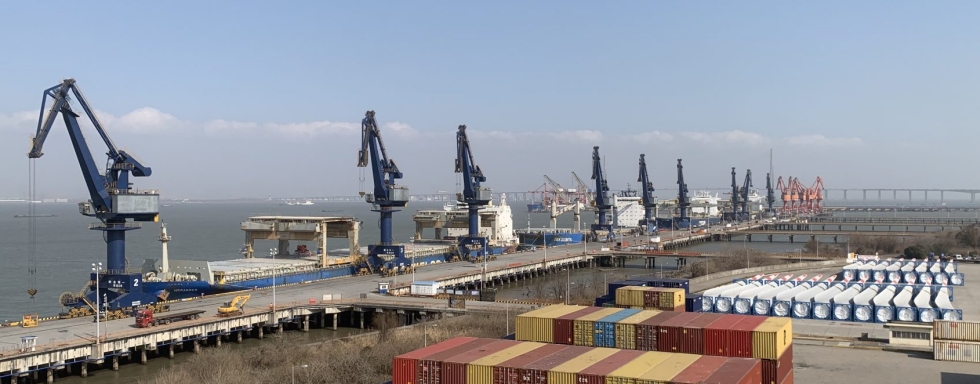
Feb. 24, 2021 - Euroports announced that its Changshu terminal, which handles wood pulp, paper, sawn timber and kaolin, kicked-off 2021 recording 1.1 million tons of terminal throughput in January.

The total discharge volume was over 600,000 mt working up to four vessels simultaneously — a new discharge volume record for the terminal.

Delivery volume was close to 500,000 mt which, on its own merit, is equally a record level, Euroports said.

Euroports congratulates its Changshu Operations Team for this great achievement and its new JV partner, ZPH, who made it possible and contributed strongly.

About Changshu Terminal

Already operating for more than 20 years, the Changshu terminal has set the standard for pulp and paper handling in China. It is the major point of entry into central China for pulp, and has become one of the largest pulp hubs in the world. Unique in China, this well-equipped, dedicated terminal offers the highest standards and a complete supply-chain package, all the way from vessel to mill.

SOURCE: Euroports


The Ports of Antwerp and Zeebrugge to Merge, Creating Port of Antwerp-Bruges

Feb. 12, 2021 - The City of Antwerp and the City of Bruges have reached an agreement to merge their respective ports. The two-city agreement marks the start of a unification process that is expected to take a year to finalise. Once completed, the ports will operate under the name “Port of Antwerp-Bruges.”

As a result of the merger, the ports will be able to strengthen their position within the global supply chain and continue their course towards sustainable growth. Furthermore, the unified port will be more resilient to the challenges of the future and will take a lead in the transition towards a low-carbon economy.

The ambition is for Port of Antwerp-Bruges to become the world's first port to reconcile economy, people and climate.

“We are proud of this historic agreement, which seals a long-awaited unification,” said Annick De Ridder, port alderman and chair of the board of directors of the Antwerp Port Authority. “By joining forces, we are on the way to becoming Europe's global port, while at the same time reinforcing our position as the most important container port in terms of tonnage, a solid RoRo port and one of the largest break bulk ports in Europe.

The shared position of the ports of Antwerp and Zeebrugge within the global supply chain will receive a significant boost. The merged port will become the most important container port (157 million tonnes/year), one of the largest break bulk ports and the largest port for the throughput of vehicles in Europe.

Furthermore, the port will account for more than 15% of Europe’s liquid natural gas transited and it will of course remain Europe's most important chemical hub.

Finally, it will be the largest port for cruise ships in the Benelux. With a total throughput of 278 million tonnes per year, the unified port will be able to consolidate its leading position in the world.

The unification project is all about creating added value for the surrounding areas of Antwerp and Zeebrugge, for customers and stakeholders, as well as for the rest of Flanders. As part of a joint plan, the two ports have defined three strategic priorities – sustainable growth, resilience and leadership in the energy and digital transition.

Combined Strengths

Port of Antwerp-Bruges will combine the best of both worlds and will focus on the strengths of each site. The ports of Antwerp and Zeebrugge are largely complementary. For example, Antwerp specialises in the handling and storage of containers, break bulk and chemical products, while Zeebrugge is a major port for RoRo traffic, container handling and the transhipment of liquid natural gas. Working more closely together will make it possible to consolidate sustainable growth, not only of each port's individual market share, but also of the joint market share of both ports together.

In order to maximise the added value of a unified port, Port of Antwerp-Bruges will seek to develop and make optimum use of the interconnectivity between the two ports. The transportation of goods by rail between the two sites will be bundled, estuary traffic (by inland vessels on the North Sea) will be optimised and pipeline connections will also be on the list of priorities.

Committed strategic investments, such as the new sea lock in Zeebrugge and the additional container capacity in Antwerp, will go ahead. Future investments will be evaluated from a unified operational perspective, so that both port platforms will benefit, and the port continues to meet its customers' expectations.

Port of Antwerp-Bruges intends to identify as many synergies as possible, to continue to build on the extensive support within society for this driver of Flanders' economy and to reinforce its position as a logistical, maritime and industrial centre. Not only within Flanders and Belgium, but on a European level and worldwide.

The transaction is subject to a number of customary suspensive conditions, including approval from the Belgian Competition Authorities. Both parties aim to finalise the transaction in the course of 2021.

SOURCE: Port of Antwerp

 
<< first < Prev 11 12 13 14 15 16 17 18 19 20 Next > last >>

Page 20 of 34