Cepi Report Warns Policymakers of Slow, Sustained Erosion in Europe's Paper Industry
 July 6, 2026 - The Confederation of European Paper Industries' (Cepi) 2025 Key Statistics Report highlights a European paper industry that is increasingly exposed to a slow and sustained erosion of its industrial base at a time when its contribution to Europe's circular economy, climate goals, and strategic autonomy remains critical. July 6, 2026 - The Confederation of European Paper Industries' (Cepi) 2025 Key Statistics Report highlights a European paper industry that is increasingly exposed to a slow and sustained erosion of its industrial base at a time when its contribution to Europe's circular economy, climate goals, and strategic autonomy remains critical.
Paper and board production declined by 1.6% in 2025, reaching 77.4 million tonnes, reflecting a continued correction after the post-pandemic surge rather than a return to stable growth. Market pulp, a strategic but relatively small proportion of the sector's production, grew by 1.0%. Early signals from 2026 point to continued weakening, with output already down 2.4% in the first quarter compared to the same period in 2025.
While overall demand has only slightly eroded, this masks important structural shifts. Production of packaging grades remained stable, despite a significant contraction for cartonboard (-5.4%) while graphic papers declined sharply (-7.3%). Overall, excluding graphic papers, European production looked relatively stable in 2025, but still 7.0% below the record levels of 2021.This reflects an intensifying global competition which effects are worsened by a difficult geopolitical context.
The industry has been steadily losing production assets over the past three years, while import penetration reached a record 7.7% of EU consumption. Exports still represent more than 20% of production, but the EU trade balance has slightly diminished in 2025. Foreign state support and asymmetric market conditions weigh on European industry's competitiveness.
This comes despite the pulp and paper producers' strong sustainability performance. Pulp and paper producers reduced specific CO2 emissions by 10.2% in 2025, continues to operate the world's most effective recycling system, and sources an all-time high 92% of its wood and nearly all of its recycled material from Europe, the sector exemplifying Europe's current 'independence moment'.
"Cepi calls for a coherent policy response that reinforces trade defence instruments, ensures a predictable and investment-friendly regulatory framework, and strengthens Europe's circular bio-based value chains," said Jori Ringman, Cepi Director General. "A slow drift may be less visible than a sudden shock, but its long-term consequences for Europe's industrial resilience, climate leadership, and strategic autonomy are no less significant."
Overall, data from Cepi's Key Statistics Report 2025 points to a clear policy imperative. Without timely action, Europe risks a gradual loss of industrial capacity in a sector that is essential for fast-moving consumer good markets, logistics, hygiene, and the development of bio-based alternatives to fossil-intensive material which would allow Europe to tap into an EUR 6.6 trillion global opportunity in emerging bioeconomy markets by 2030.
Brussels-based Cepi is a non-profit association representing the paper industry in Europe. It has four standing committees, which take long-term strategic perspectives on the issues affecting the industry. These are the Environment and Safety, Climate Change and Energy, Forest and Recycling committees under which a number of ad-hoc issue groups operate.
SOURCE: Cepi |
|
|
BC Council of Forest Industries Says the Situation in British Columbia is "Dire"
Dec. 3, 2025 - Kim Haakstad, President & CEO of the BC Council of Forest Industries (COFI) issued the following statement in response to the announcement of additional mill closures in British Columbia (Canada):
"COFI extends our deepest concern to the workers, families, and communities affected by today's closure announcement. For too many people across this province, the consequences of inaction for the struggling forestry sector are no longer theoretical — they are happening in real time.
"We have been sounding the alarm that the situation in BC is dire and today is further evidence that the sector needs an urgent response from our government. While softwood lumber duties and trade uncertainty add significant pressure, not everything can be blamed on the dispute. It is important to focus on the areas within our control, and those remain the core issues facing BC forestry: access to predictable, economic wood supply and the ability to operate in a competitive and efficient regulatory environment.
"The solutions are well known and long overdue. The provincial government must urgently:
Remove barriers to getting wood moving by improving the efficiency and timeliness of cutting permits and road-building approvals, and fast-tracking improvements to BC Timber Sales to get wood to the market.
Address operating costs both at the harvest level and in manufacturing facilities, where BC mills face mounting administrative and regulatory burdens.
Support First Nations with the capacity and tools to expedite referrals, co-develop land use plans with the BC government and industry, and increase revenue sharing — so that partnerships can move at the speed of opportunity.
"These steps are essential not only for sawmills and pulp mills, but for the entire forestry value chain — the loggers and truck drivers, the unionized mill workers, the bioenergy and mass timber producers, and the thousands of small businesses that rely on the sector. When mills close, it is not only the mill workers and their families that suffer — it is the local nurses, the gas station owners, the cafe workers and the many small businesses and service providers who keep rural and small communities alive."
"Local leaders have made it clear what these ongoing closures and curtailments mean for their communities:
"At the council office, we are concerned about the potential loss of tax revenue that will come from all the layoffs. People need to be able to feed their families before they can pay taxes. With less tax revenue, the town might not be able to afford to provide basic services for our residents, like trash collection and road clearing." – Williams Lake Mayor Surinderpal Rathor in Macleans, November 20, 2025.
"While other jurisdictions face similar trade pressures, BC's coastal forestry sector has been uniquely harmed by regulatory uncertainty. We are one pulp mill closure away from the total collapse of coastal forestry." – Campbell River Mayor Kermit Dahl at a press conference, September 22, 2025.
"We want the government to commit to the promised allowable cut of 45 million cubic metres for 2025 and maintain these levels for future years. We anticipate a continued decline in volume harvested, compounded with softwood lumber duties and U.S. tariffs, will potentially devastate the forest industry and result in the closure of more mills, meaning communities like ours will lose family-supporting jobs and major taxpayers, exacerbating the already high cost of living that our residents are facing." – North Cowichan Mayor Rob Douglas and Nanaimo Mayor Leonard Krog in a letter to Forests Minister Parmar, April 26, 2025
Haakstad continued, "We acknowledge the recent steps taken by the federal government, including enhanced liquidity supports and expanded employment relief programs. But the most effective way to protect workers is to keep their workplaces open. Now the Province must act with urgency to stabilize wood supply, restore competitiveness, and reverse the steady loss of jobs and investment.
"Without swift, decisive action, BC will continue to see more closures, more families uprooted, and more communities eroded. Instead of realizing the full potential of BC's world-leading forest products, we are continuing to lose ground domestically and globally as highest cost jurisdiction in North America.
"COFI and our members are at the table, ready to work with government, First Nations, labour, and communities to find solutions that can stabilize the sector and rebuild confidence. But we need the province to step up now — not months from now, not after further losses. The time for urgent action was yesterday," Haakstad concluded.
Forestry Facts
The average BC pulp mill contributes $200 million in GDP annually to the province. The BC forest industry:
- contributes $17.4 billion to BC's annual GDP,
- spends $6.6 billion on goods and services in BC each year,
- pays $9.1 billion in wages, salaries and benefits.
The BC Council of Forest Industries (COFI) represents the interests of British Columbia's forest industry, advocating for policies that support sustainable forest management, economic prosperity, and the well-being of forest-dependent communities.
SOURCE: Council of Forest Industries (COFI) |
A Call to 'Stop the Clock' and Ensure a Workable EU Deforestation Regulation
 Nov. 10, 2025 - Over 20 industry associations on Oct. 27 issued a joint statement about the European Commission's recent proposed amendments to the EU Deforestation Regulation (EUDR), stating, "The changes introduced by the Commission are substantial and deserve appropriate time for stakeholders, policy makers and Member States to analyse and discuss them. This is exceptionally difficult considering the deadline of 30 December 2025 currently in place." Nov. 10, 2025 - Over 20 industry associations on Oct. 27 issued a joint statement about the European Commission's recent proposed amendments to the EU Deforestation Regulation (EUDR), stating, "The changes introduced by the Commission are substantial and deserve appropriate time for stakeholders, policy makers and Member States to analyse and discuss them. This is exceptionally difficult considering the deadline of 30 December 2025 currently in place."
The following joint "open statement" is posted to the Confederation of European Forest Owners (CEPF) website:
The signatories of this open statement recall that the effectiveness of any legislative framework depends on its workability, legal clarity, and predictability. The recent amendments proposed by the European Commission to the EU Deforestation Regulation (EUDR) after the announcement of a further postponement on 23 September, prolong a situation of costly uncertainty and unrealistic implementation timelines. The new proposal, and the very challenging timeline to have it approved, risks undermining both the credibility and the practical enforcement of the Regulation, while placing European operators in an untenable position of legal and operational uncertainty.
The changes introduced by the Commission are substantial and deserve appropriate time for stakeholders, policy makers and Member States to analyse and discuss them. This is exceptionally difficult considering the deadline of 30 December 2025 currently in place. It's unrealistic and unacceptable to expect that companies will be ready to comply right away with a regulation that has been hastily renegotiated only a few weeks before entry into application. In fact, most large downstream industries will not be in the position to adapt again their IT systems, which have been designed to interact with the TRACES platform, whereas small and micro downstream operators will be faced with a much larger number of DDS reference numbers as these accumulate along the value chain. Downstream operators of all sizes will face compliance problems with the new rules, which, in the best-case scenario, will be adopted only a few days before the entry into application.
The proposal further fails to reflect the operational reality of the market, where medium-sized and large companies routinely interact with small and micro-enterprises within integrated supply chains. As a result, establishing different application dates – with large and medium enterprises required to comply from 30 December 2025, and small and micro-enterprises benefiting from twelve additional months, will, in practice, force all operators to comply from the same date. The interdependence of companies within the value chain makes the proposed postponement illusory, as smaller operators will be required to align immediately to maintain business relations.
Our sectors continue to face a serious deficit of clarity and legal certainty, which conflicts with a fundamental right guaranteed under EU law and which remains indispensable for sound business operations, competitiveness, and investment.
We therefore urge the European Commission to introduce a “stop-the-clock” mechanism that allows policymakers to have a proper and comprehensive assessment of the Regulation’s impact and implementation. Such a reassessment should aim to identify genuine simplification measures and to render the EUDR obligations truly workable, while fully preserving the Regulation’s legitimate environmental objective of combating deforestation, a goal strongly supported by the signatories of this open statement.
List of signatories:
APAG – Oleochemicals Europe
Bioenergy Europe
CEI-Bois – European Confederation of Woodworking Industries
CELCAA – European Liaison Committee for Agricultural and Agri-food trade
CEPF –Confederation of European Forest Owners
CEPI – European Confederation of the Pulp & Paper Industry
CESIO – European Committee of Organic Surfactants and their Intermediates
COCERAL – European association of trade in cereals, oilseeds, rice, pulses, olive oil, oils and fats, animal feed and agro-supply
COPA-COGECA – European Farmers and Agri-Cooperatives
COTANCE- Confederation of National Associations of Tanners and Dressers of the European Community
ECF – European Coffee Federation
ECMA – European Carton Makers Association
EDANA – Association of the nonwovens and related industries
EFIC – European Furniture Industries Confederation
ELO – European Landowners’ Organization
EOS – European Organisation of the Sawmill Industry
EPF – European Panel Federation
ETTF- European Timber Trade Federation
FEP -Federation of European Publishers
FECOF – Federation Europeenne des Communes Forestieres
FEFAC – European Feed Manufacturers’ Federation
FEFPEB – European Federation of Wooden Pallet and Packaging Manufacturers
FEP – European Parquet Federation
INTERGRAF – European Trade association of the graphic industry
UECBV – The European Livestock and Meat Trades Union
Based in Brussels, the Confederation of European Forest Owners (CEPF) is a non-profit organisation, representing the interest of nearly 16 million forest owners. These are private individuals, families and cooperatives, which take care of approximately 60% of the European forest area.
SOURCE: Confederation of European Forest Owners |
|

The Biden Administration’s Rail Regulation Efforts Make Little Sense
The Biden Administration should discard a recent proposal to impose reciprocal switching on U.S. railroads.
By Ike Brannon and Michael Gorman for The Regulatory Review
May 9, 2022 - The pandemic accelerated the amount of online shopping by U.S. residents, and a large proportion of the U.S. population has grown accustomed to eschewing stores and having most goods delivered to their homes.
This trend has increased the number of trucks on the road, which has created congestion, parking problems, and more emissions due to traffic across the country. The recently passed Infrastructure Investment and Jobs Act contains $8 billion to boost freight infrastructure and safety programs. The state of Georgia is spending $1.8 billion a year, following a state recommendation that Georgia reduce problems caused by the surfeit of trucks.
Rather than address the issue, the Biden Administration appears intent on making this problem worse by embracing several policies that would result in fewer goods traveling by rail and more being transported via highways.
The most egregious of these efforts is a 2021 Biden Administration executive order that asks the Surface Transportation Board to consider forcing railroads to engage in reciprocal switching, which would ultimately push goods off of railroads and onto trucks.
Reciprocal switching would allow shippers to choose railroads without tracks adjacent to their locales to transport their goods instead of railroads whose tracks connect directly to their facility. The railroad that owns the tracks that connect to the shipper’s facility would be forced to pick up goods for the shipper and deliver them to a competing railroad, which would carry them to the customer.
The Biden Administration avers that reciprocal switching will reduce inflation by constraining shipping prices, but the data do not show that rail prices increased more in 2021 than in previous years, so attributing any of the 2021 inflation spike to rail costs seems to be little more than dissembling.
The problem with reciprocal switching is that it effectively reduces the capacity of the rail networks. Switching trains is time and labor intensive and therefore costly. Requiring railroads to do so for competitors would impose more work in already congested networks, making it more difficult for the railroad doing the switch to optimize its train schedule.
Railroads boost capacity not only by adding or expanding tracks but also by adapting their schedules to carry more trains and fuller trains each year. Accomplishing this task is...
Read the complete article at: The Regulatory Review. |
|
Report Raises Concern of Power Shortage for Green Ports, PMSA Warns about Fallout to the Supply Chain
June 28, 2021 - The following article was published by the Pacific Merchant Shipping Association (PMSA) on June 9:
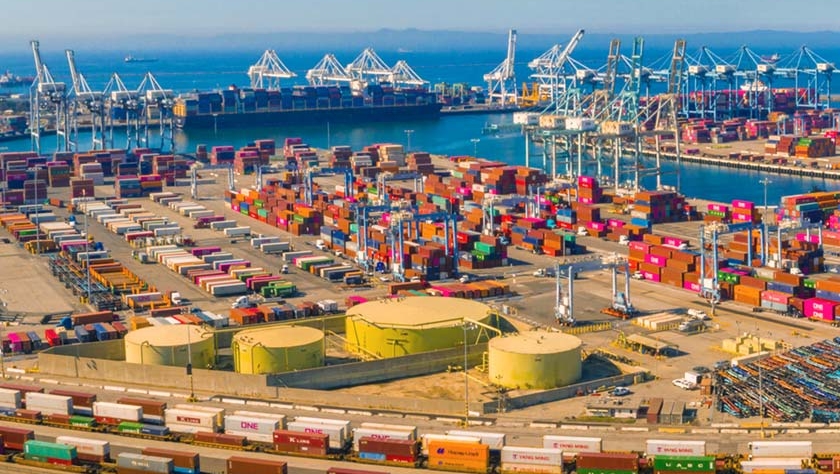
State policies requiring California’s port supply chain to transition to zero-emission technologies by 2035 need to address challenges relating to providing an adequate energy grid supply coupled with resiliency to avoid significant impacts on the ability of California’s supply chain to move cargo, according to a newly released report.
The report from engineering consultants Moffat and Nichol examines the energy grid requirements for vessels and the landside equipment that move cargo between the vessel and inland destinations. The report can be accessed here.
The report examines the state’s goal of reaching zero-emission power generation and the enormous demand power demand growth necessary to achieve that goal. With the grid already stretched to its limits, the report indicates that power demand will dramatically grow at the ports.
There is considerable risk that the transition to all-electric power creates could outstrip the ability to reliably deliver power to California’s ports without careful planning.
Failure to meet rapid power demand growth over the next decade in a reliable manner will impede the ports’ ability to move cargo resulting in nationwide economic consequences.
“This report confirms our belief that the zero-emission goal of 2035 will require complex planning, substantial funding and a level of cooperation and coordination by a myriad of state and local agencies for a massive public works project that has never been undertaken in California,” said John McLaurin, President of the Pacific Merchant Shipping Association (PMSA).
The findings identify challenges for the state’s energy plan, including:
- Ensuring sufficient power is available during marine terminal hours of operation with the ability to meet peak demand for stationery sources and electric vehicles,
- Providing additional power capacity for operations that may overlap with regional peak power demand,
- Requiring sufficient, dependable power redundancy, to allow rapid recovery from a natural or manmade disaster, and
- Executing needed improvement in the electricity infrastructure to create a stable and reliable power grid.
Cargo moves in and out of the ports on a seasonal basis, and during the peak season, prior to the holidays, operations at the ports ramp up considerably. According to Moffat and Nichol, seasonable demand requires a power system that has sufficient electric power in the evening when solar is not available, power requirements that are equivalent to powering 390,000 households, or utilizing 50% of the output of one of the reactors from the Diablo Canyon Nuclear Power Generating Station that is scheduled to be shut down by 2025 as demand ramps up.
“As federal and state elected officials consider infrastructure improvements, California public officials need to review state energy and environmental policies to ensure that California jobs and businesses are not put at risk,” concluded McLaurin.
About the Pacific Merchant Shipping Association (PMSA)
The Pacific Merchant Shipping Association (PMSA) is an independent, not-for-profit association focused on global trade. PMSA operates offices in Oakland, Long Beach and Seattle, and represents owners and operators of marine terminals and U.S. and foreign vessels operating throughout the world.
SOURCE: PMSA |
|
|